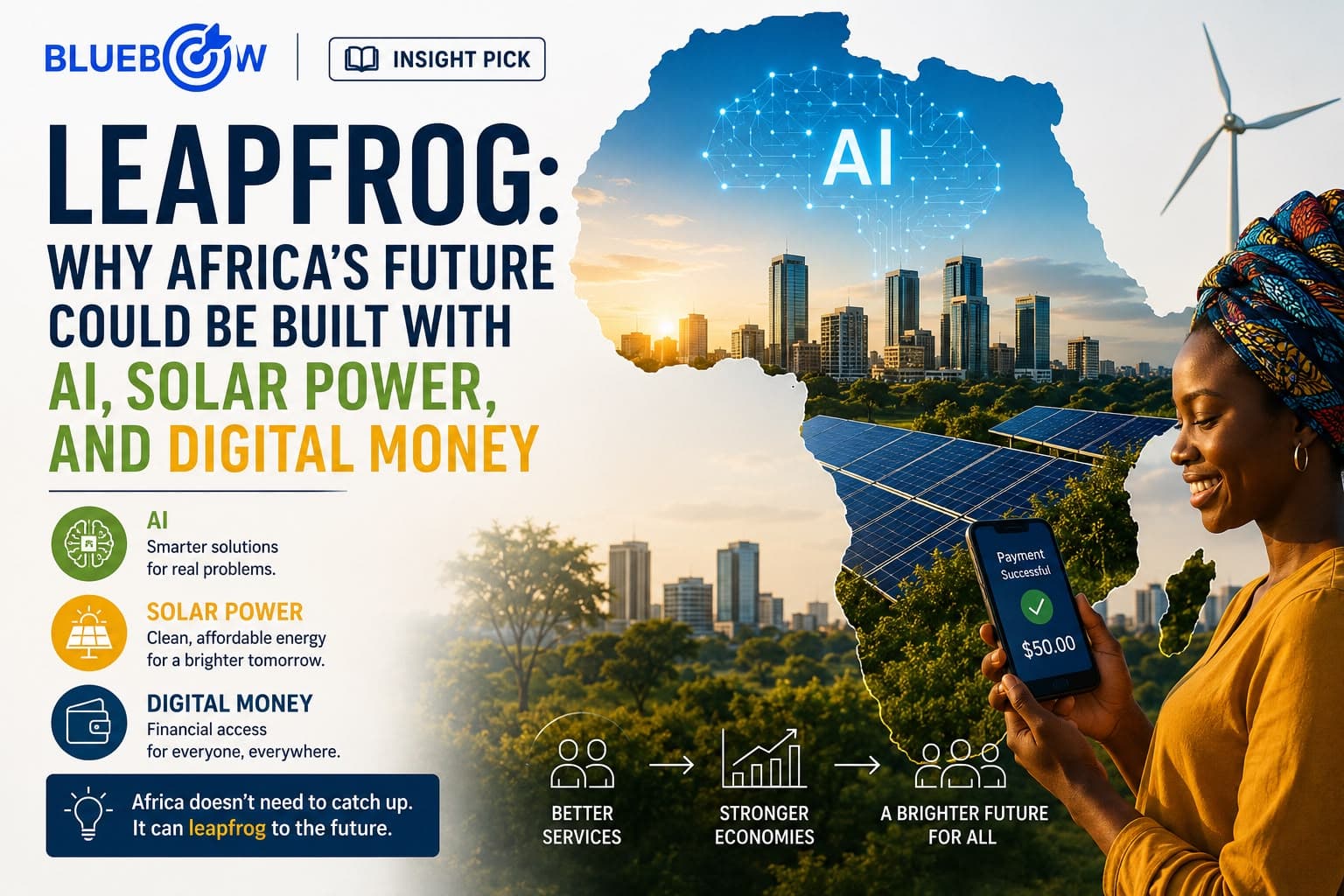
Leapfrog: Why Africa's Next Chapter May Be Written in AI, Solar, and Digital Money
Written by Serena Olisemenogor, Esq
January 17, 2026
When people talk about the next big tech breakthrough, they usually mean Silicon Valley. Karim Beguir's new book, Leapfrog, asks a different question: what if Africa didn't need to catch up at all? What if it could skip straight past the old way of doing things and go straight to the new one? That's the question behind this month's Insight pick.
Three Waves, One Continent
Beguir's idea rests on three things happening at once: artificial intelligence, renewable energy, and digital money. Each one is a big deal on its own. Put together, he says, they let a whole continent skip the slow, expensive stuff that older economies had to build first, things like landlines, coal power plants, and paper-based banks. Instead, Africa can go straight to solar power, mobile-first digital currency, and AI tools that can do work that used to need a room full of PhDs.
That's the leapfrog part. It's not about catching up. It's about skipping the queue entirely. When both computing power and energy are getting cheaper and easier to access, the advantage goes to whoever moves fastest to build for that new reality, not whoever spent the most money on the old way of doing things.
From Two Laptops to a Global AI Company
This isn't just theory for Beguir. He co-founded InstaDeep with two laptops and 2,000 dollars, and grew it into a globally recognised AI company. That hands-on experience shows up throughout the book. This isn't someone guessing about the future, it's someone who has actually built at the edge of these three waves and knows exactly where things get hard.
Why It's On Our Reading List
At BlueBow, we usually start with the same question Beguir asks, just on a smaller scale: who is this actually for, and what does their life look like right now? Not what we assume. The real thing. Leapfrog is a good reminder that the biggest opportunities rarely come from copying someone else's plan. They come from understanding where you actually stand, clearly enough to skip the steps that don't apply to you.
Whether we're looking at a recruitment process, a council service, or a whole continent's power grid, the discipline is the same: research first, evidence always, and the courage to build for where people are actually headed, not where the last generation of systems assumed they'd stay.