Nobody did the Research. Someone paid the Price
Written by Nnamdi Mba
March 7, 2026
There's a particular kind of research report that everyone in this industry recognises. Glossy cover. Confident executive summary. A handful of quotes from "user interviews" that somehow all support exactly what the client wanted to hear. Six weeks of work, and yet somehow it landed on the one conclusion that required no uncomfortable changes to anyone's roadmap.
We've all seen it. And if we're honest, most of us have seen it more than once.
Research has become a box to tick rather than a discipline to practise. A handful of interviews get dressed up as "extensive user research." A survey with leading questions gets presented as objective evidence. A two-day sprint gets billed as a full discovery phase. Nobody sets out to do bad research on purpose, but half-hearted effort, rushed timelines, and a reluctance to hear inconvenient answers all add up to the same result: research that tells organisations what they want to believe, not what's actually true.
Someone Always Pays for That Shortcut
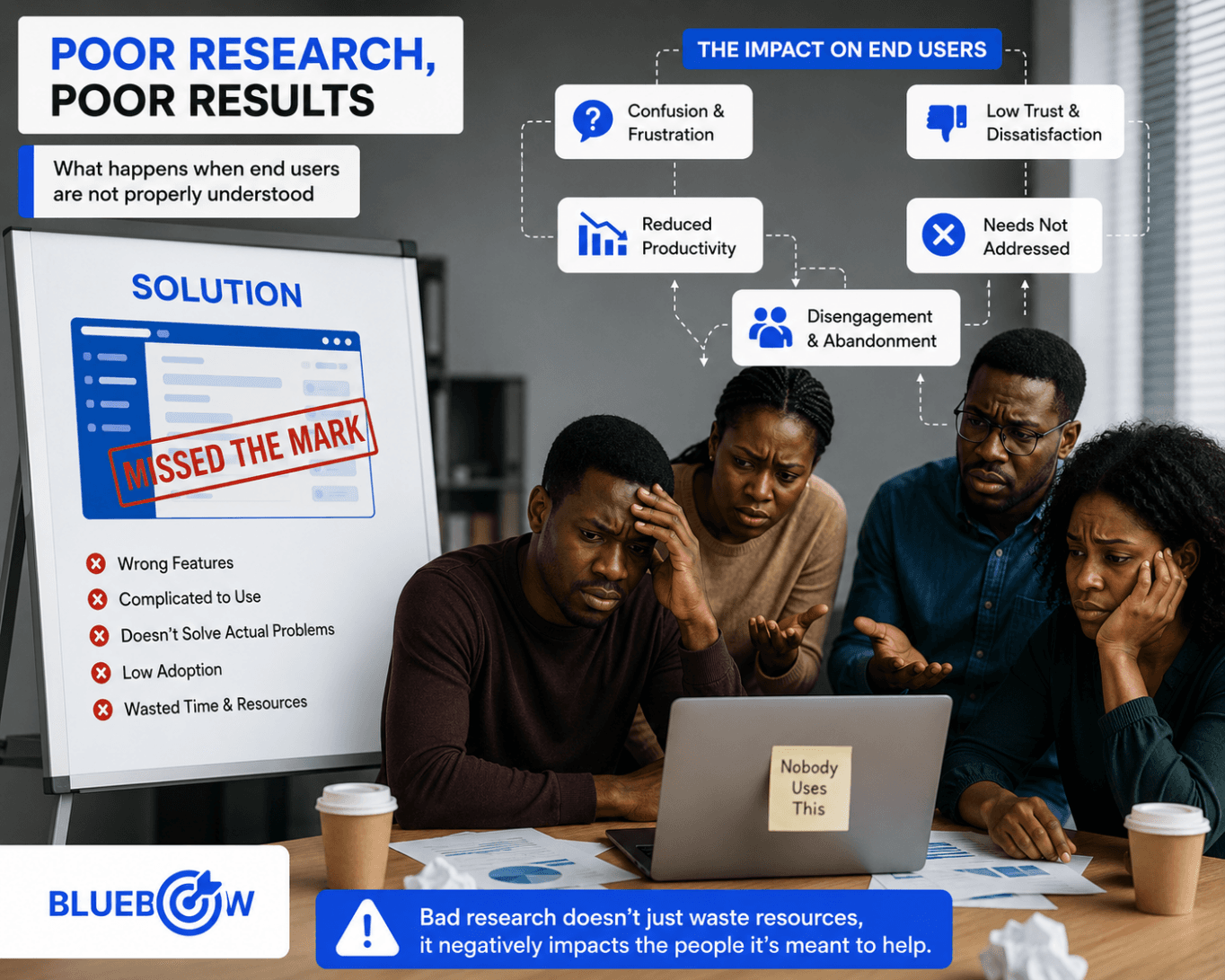
The uncomfortable truth is that lazy research doesn't just waste a budget line, a potentially live saving service gets built on top of it . A recommendation from a rushed study becomes a design decision. That design decision becomes a live service. And the live service is what a real person, a patient, a claimant, a recruit, a customer has to struggle through months or years later.
When research skips due diligence, the people who pay for it are rarely in the room where the report gets presented. It's the elderly resident who can't complete a council form online because nobody actually tested it with someone their age. It's the recruit who abandons an application because a "streamlined" process was never tested against how confusing it actually felt. It's the patient whose data doesn't follow them through a system that was declared "user-tested" after a handful of rushed sessions.
Bad research is invisible right up until it isn't. And by the time it becomes visible, it's usually a lot more expensive to fix than it would have been to do properly the first time.
Why We Built BlueBow to Do the Opposite
We didn't start BlueBow to produce nicer-looking reports. We started it because we kept seeing the pattern above play out across government and industry, and we thought organisations and the people those organisations serve deserved better than research as a formality.
That means a few things stay non-negotiable for us, on every single engagement:
We go to where the real behaviour is, not where it's convenient to observe it. Our work on the UK's armed forces recruitment transformation meant sitting inside one of the most complex, high-pressure systems in government, because a recruitment journey can't be understood from a conference room.
This work is not meant to be glamorous, It's slower than the alternative. It involves more conversations, more revisions, more moments of being told an assumption was wrong. But it's the only version of research that's actually worth the name.
Rigour Isn't Optional
We're not interested in being the fastest research partner in the room, or the cheapest. We're interested in being the one whose findings still hold up a year later, when they've been built into a live service and real people are depending on them.
Every T crossed. Every I dotted. Every uncomfortable finding reported honestly, even when it wasn't the one anyone wanted. That's not a slogan for us, it's simply what we think research is supposed to mean.