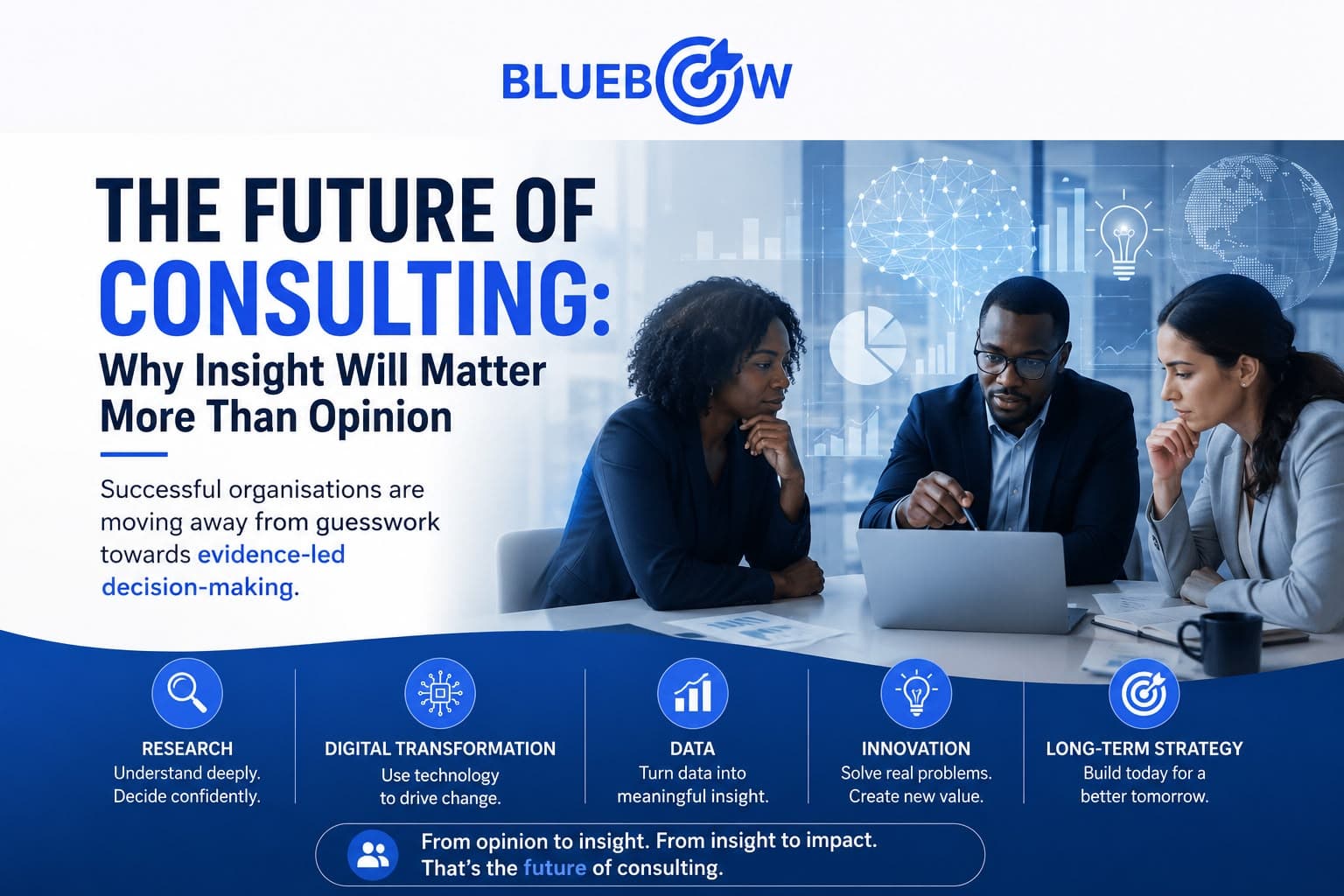
The Future of Consulting: Why Insight Will Matter More Than Opinion
Written by O'Tega Temienor
May 11, 2026
For a long time, consulting ran on confidence. A senior person walked into a room, gave their opinion, and the organisation acted on it because of who they were, not because of what they'd found. That model is fading. The organisations getting real results now aren't the ones with the most confident voice in the room. They're the ones who did the work to actually know what's true before they said anything at all.
From Opinion to Evidence
Opinion is fast. It doesn't need a budget, a timeline, or a plan. That's exactly why it's so tempting, and exactly why it's so risky. An opinion can be wrong in ways nobody notices until the project has already launched and the money is already spent. Research is slower, but it tells you something an opinion never can: whether you're actually right. The shift happening across consulting right now is simple to describe and hard to do, replacing confident guesses with evidence, even when the evidence takes longer to gather.
Digital Transformation Needs a Foundation
Every organisation says it's going through a digital transformation. Far fewer can say what problem that transformation is actually solving, for whom, and how they know. A new platform or app built on assumptions is still just a guess, dressed up in better technology. The organisations doing this well treat the technology as the last step, not the first one. They start by understanding the people and processes involved, and only then decide what, if anything, needs to be built.
Data Is Only Useful If You Ask It the Right Question
Most organisations already have more data than they use well. The problem usually isn't a shortage of numbers, it's a shortage of the right questions. Data can show you where people drop off, what they click, and how long they wait, but only once someone has decided what's actually worth measuring. Good consulting today spends real time figuring out which questions matter before it ever opens a dashboard. Without that step, data just becomes noise that happens to have decimal points.
Innovation Isn't a Brainstorm, It's a Discipline
Innovation has a reputation for being about big, sudden ideas. In practice, the organisations that innovate well treat it as a repeatable process, not a lightning strike. They test small, learn fast, and let real feedback shape the next step, rather than betting everything on one big idea that nobody outside the building has actually seen yet. That discipline is what separates genuine innovation from an expensive guess with a good pitch deck behind it.
Strategy Has to Outlast the Trend
It's easy to build a strategy around whatever technology or trend is loudest this year. It's much harder, and much more valuable, to build one that still makes sense five years from now. Long-term strategy has to be built on things that don't change as fast as the headlines do: how people actually behave, what they actually need, and where the real friction in a system sits. Insight-led consulting holds onto that longer view, even when the pressure is to chase whatever's trending this quarter.
Where BlueBow Stands
We built BlueBow around the belief that this shift isn't a trend, it's the direction the whole industry is heading. Clients don't come to us for an opinion delivered with confidence. They come to us because we do the research first and let the evidence lead, even when that means telling them something they didn't expect to hear.
The future of consulting won't belong to whoever sounds the most certain in the room. It will belong to whoever actually took the time to find out what's true. That's the kind of consulting we're building BlueBow to be.