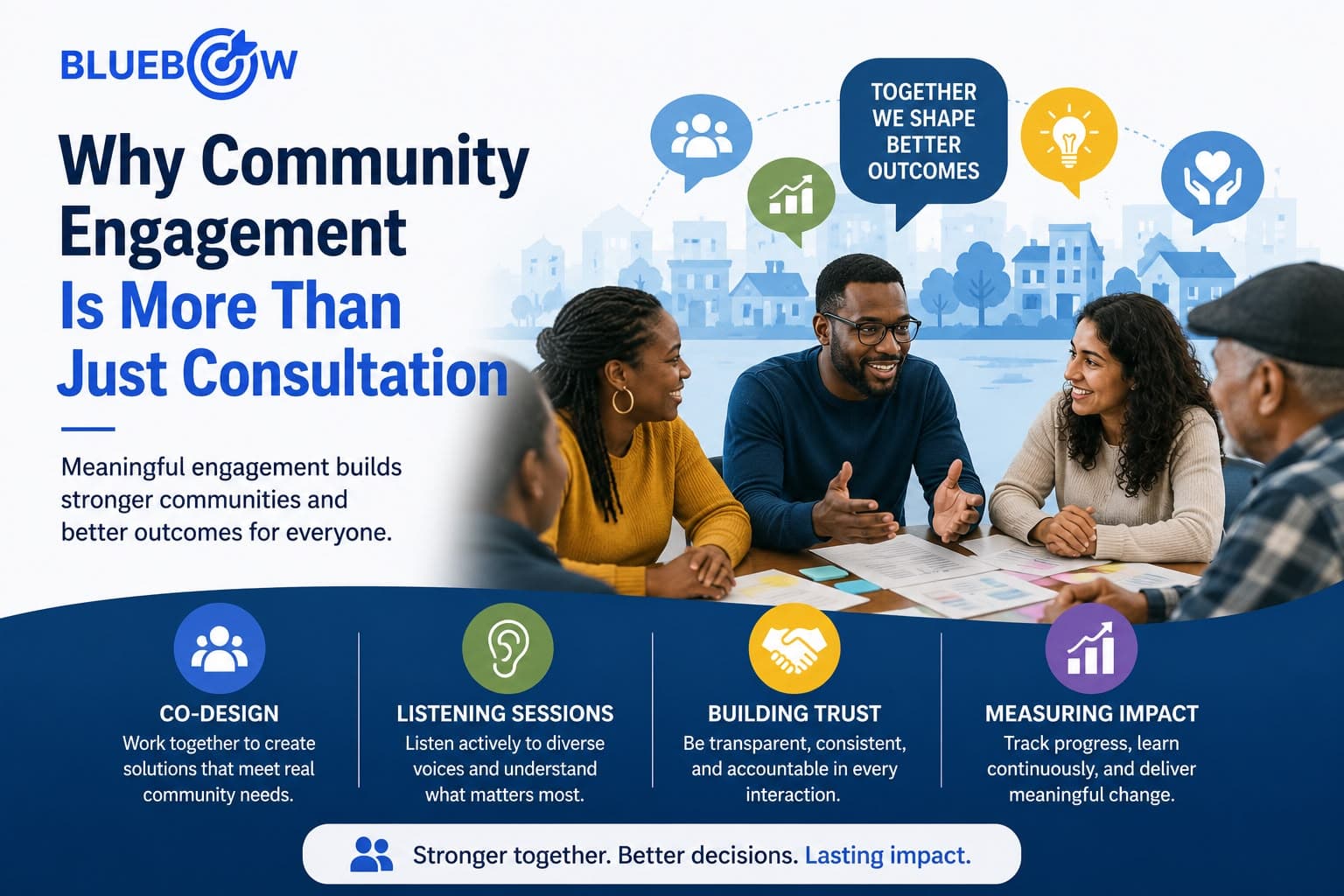
Why Community Engagement Is More Than Just Consultation
Written by Micheal Adekanye
June 8, 2026
A lot of organisations say they've “consulted the community” when what actually happened was a survey nobody read the results of, or a single public meeting held on a weekday afternoon when most people were at work. That's not engagement. It's a box being ticked. Real community engagement is slower, harder, and far more useful, and it looks nothing like a consultation exercise.
Co-Design: Building With People, Not For Them
Consultation asks people to react to something that's already been decided. Co-design asks them to help shape it before it's decided. That difference matters more than it sounds like it should. When people help design a service from the start, the end result fits how they actually live, not how an organisation assumed they lived. It also tends to catch problems early, while they're still cheap to fix, instead of after launch, when they're not.
Listening Sessions: Showing Up Without an Agenda
A good listening session isn't a presentation with a Q&A bolted on the end. It's the organisation showing up to actually listen, without already knowing what it plans to say back. That means meeting people at a time and place that works for them, not just the organisation's calendar. It means letting silence sit instead of rushing to fill it. And it means being willing to hear things that are uncomfortable, without getting defensive about them. People can tell the difference between being heard and being humoured, and it changes how much they're willing to say.
Building Trust: The Part That Can't Be Rushed
Trust isn't built in a single meeting, and it definitely isn't built by promising things an organisation can't deliver. It's built by doing what you said you would, showing up again after the first conversation, and being honest when the answer is “we can't do that” instead of going quiet. Many communities have been consulted before, sometimes more than once, and seen nothing change afterwards. That history doesn't disappear because a new project has good intentions. It has to be rebuilt, one kept promise at a time.
Measuring Impact: Proving It Actually Mattered
Engagement without a way to measure impact is just activity. Did the service actually get easier to use because of what people said? Did the thing they raised in a listening session actually change the final design, or did it get quietly dropped? Real engagement can point to specific decisions that changed because of specific things a community said. If it can't, that's usually a sign the input was collected but never really used.
Why We Take This Seriously
At BlueBow, we treat community engagement the same way we treat any other kind of research: it only counts if it actually changes what gets built. That means going beyond the survey and the single public meeting, and doing the slower work of co-design, real listening, and trust that gets earned over time rather than assumed on day one.
Consultation asks a community to react. Engagement asks them to help build. The second one takes longer, but it's the only one that actually works.